


How to Teach History to Boys: 7 Proven Methods
Table of Contents
- Why Boys Disengage From Traditional History Teaching
- Start With Action-Driven Narratives Instead of Textbooks
- Use Storytelling and Historical Biographies to Build Connection
- Teaching Military History to Children Through Primary Sources
- Interactive Discussion Techniques That Keep Boys Engaged
- Hands-On Projects and Gamification for Kinesthetic Learners
- Building a Homeschool History Curriculum for Boys That Sticks
- Frequently Asked Questions
Last Updated: September 19, 2026
Why Boys Disengage From Traditional History Teaching
Most boys don't hate history. They hate how it's taught, and that's exactly why learning how to teach history to boys matters.
Textbooks present history as a list of dates, names, and disconnected events. Boys need movement, action, and narrative tension. When history feels like memorization, they check out. The moment you shift to storytelling and real human drama, something changes.
Boys crave understanding through action and consequence. They want to know why battles mattered, how leaders made impossible decisions, and what happened next. Traditional curriculum often skips this entirely. It focuses on what happened, not why it gripped people at the time.
The good news: this is fixable. Teaching history to boys works when you match the content to how they naturally learn. Boys respond to narratives with clear stakes, visual evidence, and opportunities to engage actively. That's not a limitation of boys, it's a feature you can use.
Start With Action-Driven Narratives Instead of Textbooks
Textbooks flatten history into passive information. Narratives bring it alive.
An action-driven narrative puts the reader inside a moment. Instead of "The American Revolution began in 1775," try: "Washington's army was starving. It was Christmas night. The British weren't expecting an attack because no general would be crazy enough to cross an icy river in the dark. That's exactly what Washington did."
That's the difference between information and engagement.
Boys respond to narratives because they create emotional stakes. You're not asking them to memorize facts, you're inviting them to experience history as it unfolded. The best homeschool history curriculum for boys uses this approach consistently.
Great Battles for Boys uses this exact method. Each chapter tells a complete story with tension and resolution. Readers finish a chapter and want to keep going because they're invested in what happens next, not because they have to.

Use Storytelling and Historical Biographies to Build Connection
Historical figures become real when you tell their stories as people, not as textbook entries.
Biographies work because they show decision-making in real time. Boys see how Alexander the Great thought about strategy. They understand why George Washington took risks that could have destroyed his army. They learn that historical figures were people solving problems with incomplete information, just like we do now.
The most engaging approach combines biography with narrative. Don't just list facts about a leader. Show them in action. What did they do when they faced their biggest challenge? How did they think? What did they sacrifice?
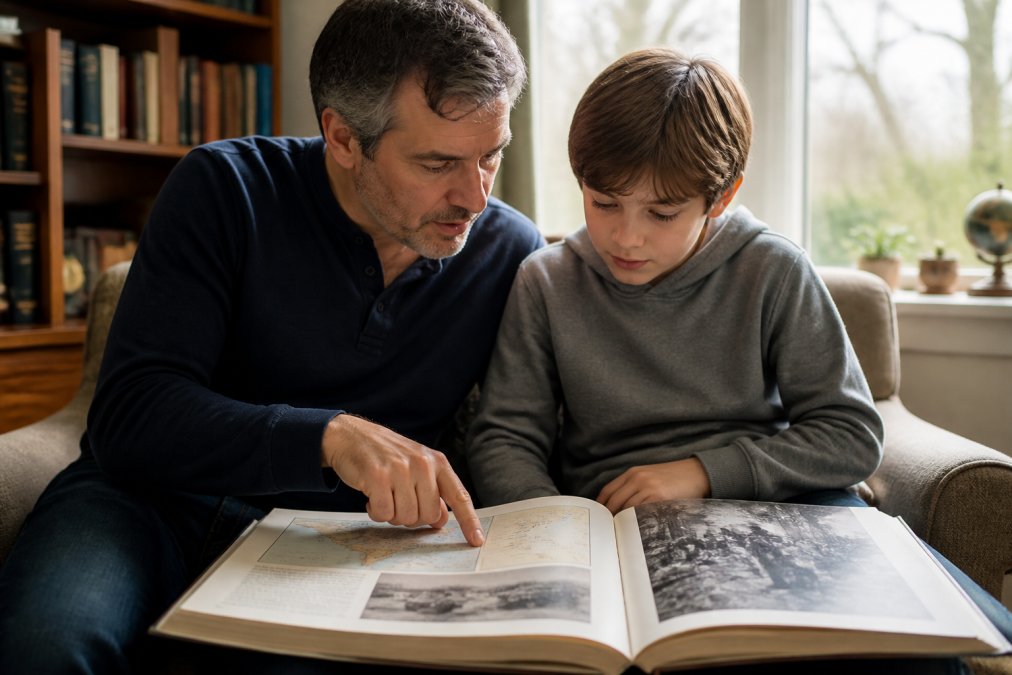
When you teach history to boys through biography, you're teaching critical thinking without calling it that. Boys start asking: Would I have made the same choice? Why did this leader succeed when that one failed? What would I have done differently?
This approach builds historical empathy. Boys stop seeing history as "stuff that happened" and start seeing it as human choices with real consequences. That shift is everything.
Include biographies of different types of leaders: military strategists, political figures, explorers, and ordinary soldiers. Show boys that history wasn't made by one type of person. It was made by people with different skills, backgrounds, and approaches.
Teaching Military History to Children Through Primary Sources
Primary sources are the actual evidence of history. They're more powerful than any textbook.
A primary source is something created during the time period you're studying. Letters from soldiers.
Maps and Visual Aids as Primary Source Tools
Maps are the most underused tool in teaching history to boys. They're incredibly powerful.
Connecting Battles to Broader Historical Context
A battle doesn't exist in isolation. It's part of a larger story.
Interactive Discussion Techniques That Keep Boys Engaged
Discussion transforms passive learning into active thinking.
Use these discussion techniques:
- Debate format: Give boys opposing sides of a historical decision. Have them argue why their side was right. This forces them to understand both perspectives and think critically.
- What would you do? Pause at key moments and ask boys what they would have done. Let them defend their choices against historical outcomes.
- Cause and effect chains: Ask boys to trace how one decision led to another. What would have happened if a leader had chosen differently?
- Character perspective: Have boys explain events from different characters' viewpoints. How did a soldier see the battle differently than a general?
- Current events connection: Connect historical events to modern situations. What lessons apply today?
Hands-On Projects and Gamification for Kinesthetic Learners
Some boys learn best by doing. Hands-on projects and games activate different learning pathways. Our Curriculum offers many of these projects and covers a variety of learning styles.
Effective project ideas:
- Design a battle map: Have boys create their own maps showing terrain, troop positions, and movement. They have to understand geography and strategy to do this well.
- Build a model fortress or fortification: Using cardboard, blocks, or other materials, boys can construct defensive structures. This teaches engineering and tactical thinking.
- Create a timeline: Have boys research events and place them on a visual timeline with images and brief descriptions. This builds research skills and historical sequence understanding.
- Write from a soldier's perspective: Have boys write letters, diary entries, or reports from someone who lived through a historical event. This builds empathy and writing skills simultaneously.
- Debate or mock trial: Organize structured debates about historical decisions. Boys research both sides and present arguments.
Book selection makes or breaks reluctant reader engagement.
Reluctant readers need books with specific features. Short chapters let them finish a complete story in one sitting. Real photographs make history visual. Clear, direct writing avoids dense paragraphs that overwhelm.
Look for these characteristics:
- Short chapters: Each chapter should be completable in 10-15 minutes. This gives boys a sense of accomplishment and momentum.
- Visual content: Photographs, maps, and diagrams should appear regularly. Boys process visual information quickly.
- Action-oriented narratives: The story should move forward. Boys lose interest in slow, descriptive passages.
- Real consequences: Show what actually happened and why it mattered. Boys respond to stakes and outcomes.
- Accessible language: Complex sentences and vocabulary slow reluctant readers down. Clear, direct writing keeps them moving.
Building a Homeschool History Curriculum for Boys That Sticks
An effective homeschool history curriculum for boys includes:
- A clear narrative arc: Cover history chronologically or thematically, but make sure there's a coherent story. Boys understand patterns when events connect logically.
- Regular primary source engagement: Include maps, photographs, letters, and documents regularly. Don't just read about history; interact with its evidence.
- Discussion and debate: Build in regular opportunities for boys to talk about what they're learning. This deepens understanding and keeps them engaged.
- Hands-on projects: Include at least one project per unit. Boys remember what they create.
- Reading at the right level: Choose books that match your son's reading ability and interests. Frustration kills engagement.
- Connection to current events: Help boys see how history explains the world today. This makes learning feel relevant.
Frequently Asked Questions
How can I teach military history to children without glorifying violence?
Teaching military history to children requires balancing tactical strategy with human consequence. Focus on leadership decisions, strategic thinking, and how historical figures solved problems under pressure. Use primary sources like letters and accounts that show soldiers' humanity. Connect battles to broader historical context: why the conflict started, what changed afterward, how it shaped society. This approach teaches critical thinking and historical empathy rather than celebrating combat, helping boys understand history's complexity.
What should a homeschool history curriculum for boys include to maintain engagement?
A homeschool history curriculum for boys works best when it combines short reading chapters with hands-on projects, quizzes that reinforce learning, and discussion prompts. Include maps and photographs so visual learners stay engaged. Vary activities: some kinesthetic (building, designing, creating), some analytical (discussing strategy, comparing historical figures), some creative (writing, imagining scenarios). The Great Battles for Boys Curriculum includes 150+ quizzes and final projects for every book, designed specifically to keep active boys motivated throughout the year.
How do I know if a history book is right for a reluctant reader?
Look for books with short chapters (each completable in one sitting), real photographs instead of illustrations, and a narrative pace that moves quickly. Avoid dense paragraphs and heavy academic language. Check if the book is written by someone with teaching experience—they understand how reluctant readers think. Read sample chapters yourself first. Engaging history books for reluctant readers typically feature action-oriented stories, clear maps, and biographies of historical figures rather than abstract concepts. Many reluctant readers will ask to keep reading if the story hooks them immediately.
Leave a comment