
Why Boys Hate Reading School Books: 7 Reasons

Table of Contents
- Why Boys Hate Reading School Books: The Core Reasons
- Why Boys Prefer Nonfiction Over Fiction
- Nonfiction Books for Boys Who Hate Reading: What Actually Works
- How to Motivate Reluctant Readers at Home and in Class
- How to Motivate Reluctant Readers: Practical Strategies That Stick
- The Male Role Model Effect: When Boys See Men Reading
- Audiobooks and Digital Literacy: Meeting Boys Where They Are
- Frequently Asked Questions
Last Updated: September 14, 2026
Why Boys Hate Reading School Books: The Core Reasons
Ask a room of parents and teachers why boys hate reading school books, and you will hear the same frustrated refrain: "He used to love stories, and then something changed." That change usually happens in upper elementary or middle school, right around the age when assigned reading replaces chosen reading.
The Great Battles for Boys team hears this from families every week, and the pattern is remarkably consistent. Boys do not hate reading. They hate being told what to read, when to read it, and how to prove they did it.

According to the National Center for Education Statistics, boys consistently score below girls on reading assessments through elementary and middle school. The gap is not about ability. It is about engagement, and engagement collapses when reading stops feeling like a choice.
Forced Reading Requirements Kill Intrinsic Motivation
Intrinsic motivation is the internal drive to read for enjoyment, curiosity, or personal interest, without external pressure or reward. When a boy must read a specific novel by a specific date and pass a test on it, that internal drive has no room to operate. Many teachers and parents find that required reading logs and comprehension quizzes turn a hobby into homework. The book becomes a task to survive, not a story to enjoy.
A common mistake is assuming a boy who refuses assigned novels simply dislikes reading. In practice, that same boy will devour a book about tanks, fighter planes, or ancient warriors if nobody assigns it.
Reading Anxiety and Public Performance in Classrooms
Reading anxiety is the stress a student feels when asked to read aloud or answer questions about a text in front of peers. For boys already struggling with reading fluency, round-robin reading is a public audition they know they will fail. The classroom environment turns silent struggle into visible embarrassment, and boys respond by disengaging before anyone notices.
Why Boys Prefer Nonfiction Over Fiction
The preference for nonfiction is not a phase. It is a documented pattern in reading research and one that classroom libraries often ignore.
Boys tend to gravitate toward text that delivers facts, action, and real-world stakes. Fantasy novels ask readers to invest in invented worlds and character relationships, which many boys find slow to build. Nonfiction, by contrast, offers immediate payoff: a battle, a machine, a person who actually existed. Narrative preference varies by individual, but the aggregate trend is clear enough that publishers have started paying attention.
This is where most literacy programs get it backward. They treat fiction as the gateway and nonfiction as the reward for strong readers. For many boys, it works the other way around.
Nonfiction Books for Boys Who Hate Reading: What Actually Works
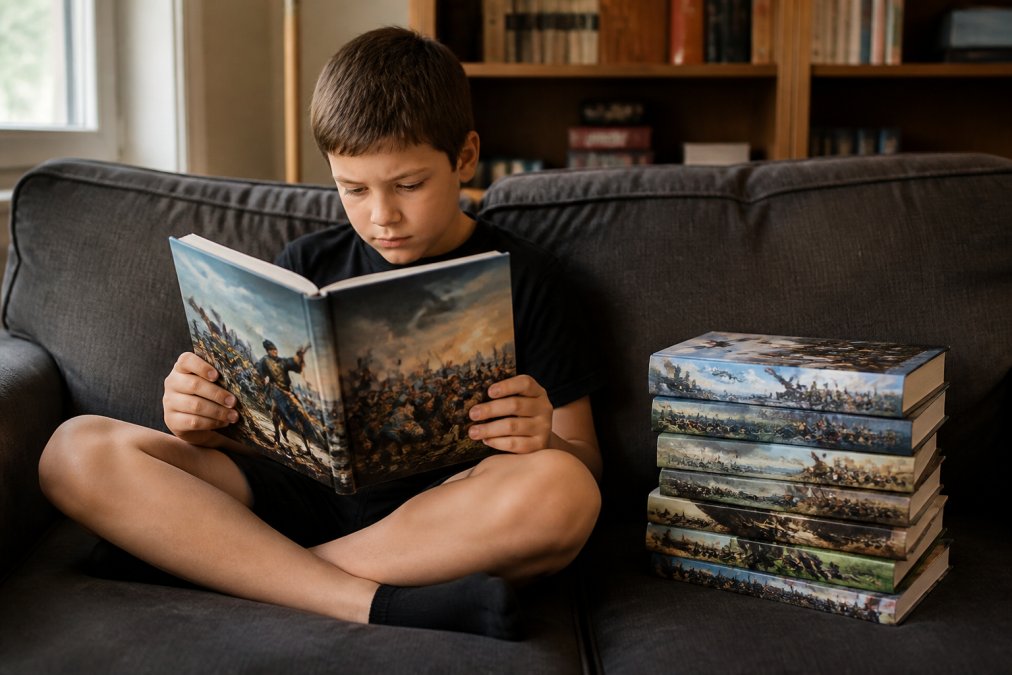
The nonfiction that works for reluctant male readers shares three traits: short chapters, visual anchors, and real stakes. A book that respects a boy's attention span and gives him something to look at every few pages will outperform a dense novel every time.
| What Reluctant Readers Need | Why It Works | What to Look For |
|---|---|---|
| Short chapters | Lowers the barrier to starting | 3-6 pages per chapter |
| Real photographs | Adds credibility and visual interest | Battlefield and archival images |
| Maps and diagrams | Satisfies tactical curiosity | Clear, labeled battle maps |
| Real stakes | Feels important, not made up | True events and people |
| Topic choice | Preserves student autonomy | Multiple eras and wars |
How to Motivate Reluctant Readers at Home and in Class
Motivating a reluctant reader starts with removing pressure, not adding rewards. Sticker charts and pizza coupons can work briefly, but they teach a boy that reading is a transaction. The goal is to get him to the point where the next chapter is its own reward.
Here is a sequence that works for most families:
- Let him pick the topic first, then find books inside that topic.
- Start with audiobooks or read the first chapter aloud together.
- Keep sessions short, ten to fifteen minutes is enough.
- Never quiz him right after reading.
- Let him abandon a book that is not working.
- Leave books visible in the car, the kitchen, and beside the couch.
- Model reading yourself, in the same room, at the same time.
How to Motivate Reluctant Readers: Practical Strategies That Stick
Strategies that stick share one feature: they protect student agency. A boy who feels ownership over what he reads will keep reading after the novelty wears off. A boy who is managed into reading will stop the moment the management ends.

For classroom teachers, the highest-use change is replacing whole-class novels with independent reading blocks and choice menus. For homeschooling parents, the equivalent move is letting history reading count as history, not as a separate reading assignment. Curriculum requirements still get met, but the pedagogical approach shifts from compliance to curiosity.
The Male Role Model Effect: When Boys See Men Reading
Boys copy what they see men do. If the men in a boy's life never read for pleasure, reading registers as a female activity, and many boys quietly opt out to protect their identity. This is the male role model effect, and it is one of the most underused tools in literacy intervention.
Most literacy advice treats reading as a solo skill to be built, which misses the social dimension entirely. Boys in the upper-elementary and middle-school years are actively sorting out what counts as masculine, and they take their cues from the men around them. When a boy's mental image of a reader is a female teacher, a female librarian, and a female parent, the activity gets filed under 'not for me', not because anyone said so, but because nobody showed him otherwise. The American Library Association has long documented how role modeling shapes children's reading habits and library use.
The fix is not to hand a boy a book and tell him reading is manly. It is to make male reading visible and specific. Three moves do most of the work:
1. Read where he can see you. A father, grandfather, uncle, or coach who reads a history book, a sports biography, a car manual, or a news article in the same room as a boy is sending a message that costs nothing and lands harder than any lecture. The content matters less than the visibility. A man reading a fishing magazine on the couch teaches the same lesson as a man reading a novel at a desk.
2. Talk about what you read, not that you read. 'I read a chapter about the Battle of Midway last night, the pilots had about five minutes of fuel to find the enemy fleet' does more than 'I like to read.' Boys respond to content, stakes, and facts. A man who shares a specific thing he learned makes reading look like a source of information and status rather than a quiet indoor hobby.
3. Match the material to the man. A father who has never finished a novel in his life should not perform novel-reading to set an example. He should read what he actually reads, the sports section, a truck repair guide, a biography of a coach, a book about a war or a machine. Authenticity matters more than literary ambition. A boy can tell when the modeling is staged.
What about the household where no man reads? This is more common than the advice literature admits, and it is not a dead end. Three workarounds hold up:
- Recruit a male reader from outside the home. A grandfather, an uncle, a family friend, a coach, a youth pastor, or a librarian who happens to be a man. One visible male reader is enough to break the 'reading is for girls' association.
- Use male authors and male subjects as proxies. A boy who reads a book written by a male veteran, athlete, or historian is still absorbing the message that men produce and consume text. The author's note or back-cover bio does this work quietly.
- Reframe what counts as reading. A man who reads game wikis, sports stats, or repair forums is reading. Pointing that out to a boy, 'your uncle reads every night, he just reads about engines', widens the definition instead of narrowing it.
Timing matters. The male role model effect is strongest in grades 3 through 8, the same window where reading identity solidifies and where boys begin to sort activities by gender. A boy who sees men reading during those years is far less likely to conclude that books are not for him. After that window, the effect still works, but it competes with a more settled self-image.
The male role model effect is not about turning boys into readers through imitation alone. It is about removing the quiet assumption that reading is something the women in his life do and the men in his life avoid. Once that assumption is gone, the other strategies in this article, choice, nonfiction, audiobooks, low-pressure reading time, have room to work.
Audiobooks and Digital Literacy: Meeting Boys Where They Are
Audiobooks are not cheating. They are a legitimate literacy tool, and for boys with dyslexia, ADHD, or other learning barriers, they remove the decoding lag that makes reading feel like work. A boy can absorb content at the speed his brain actually processes it, then return to print with more confidence.
Great Battles for Boys offers the complete series in audiobook format, which lets a family pair listening with the physical book. Many parents find that hearing a chapter first makes the printed page far less intimidating on the second pass. This is the same digital literacy overlap that shows up in gaming: boys who read game wikis, strategy guides, and lore pages are reading constantly, just not in a form most schools count.
Frequently Asked Questions
Why do boys struggle with reading more than girls?
Boys often lag behind girls in reading partly because of developmental differences in fine motor skills and because many classroom texts skew toward fiction and emotional themes that don't match boys' interests. Research shows boys are more likely to engage with nonfiction, action-driven stories, and visual content. When schools emphasize novels and literary canon over topics like battles, sports, or how things work, boys can lose motivation and fall into a cycle of low confidence and avoidance.
Are boys naturally less interested in fiction than nonfiction?
Many boys gravitate toward nonfiction because it offers facts, action, and clear outcomes. Fiction can feel slow or emotionally complex if the story doesn't connect to their interests. That doesn't mean boys can't enjoy fiction, but when given a choice, many prefer real-world topics like military history, survival, or sports. Series like Great Battles for Boys tap into that preference with short chapters and real photographs, which keep boys turning pages without feeling like they're doing schoolwork.
How can parents encourage reading at home without making it feel like schoolwork?
Start by letting your son choose what he reads, even if it's a graphic novel, a magazine about tanks, or an audiobook. Set aside 15-20 minutes of quiet reading time where everyone in the family reads, and avoid quizzing him afterward. Pair books with activities he already enjoys, like watching a historical documentary or building a model. When reading feels like a choice rather than an assignment, boys are far more likely to stick with it and build fluency over time.
My son has ADHD and gets overwhelmed easily. Will short chapters and pictures really help him focus?
Short chapters and visual elements can make a real difference for boys with ADHD or dyslexia. Breaking text into smaller chunks reduces the cognitive load and gives frequent stopping points, which helps sustain attention. Real photographs and maps also provide context that supports comprehension. Many parents report that high-interest series with punchy chapters keep their sons engaged longer than traditional chapter books, because each page delivers action or a clear fact rather than lengthy description.
Boys who hate reading school books are not broken readers. They are readers who have not yet been handed the right book. Great Battles for Boys exists to close that gap, with short, punchy chapters, real battlefield photographs, clear battle maps, and a full audiobook set for boys who learn better by listening. Get started with Great Battles for Boys and watch "I hate reading" turn into "just one more chapter."


Leave a comment