
Educational Gifts for 12 Year Olds: 2026 Guide

Table of Contents
- Quick Comparison: Best Educational Gifts for 12 Year Olds
- STEM Kits for Middle Schoolers That Build Real Skills
- Best History Books for 12 Year Old Boys
- How to Encourage Reading in Reluctant Readers
- Science Experiment Sets and Creative Educational Gifts for 12 Year Olds
- Logic, Strategy, and Screen-Free Learning Activities
- Gifts That Work for Neurodivergent Kids and Different Learning Styles
- Which Educational Gift Should You Actually Buy?
Last Updated: August 25, 2026
Finding the right educational gifts for 12 year olds is harder than it looks. At this age, kids are sharp enough to reject anything that feels like homework in disguise, but curious enough to go deep on topics that actually grab them. Below, we break down the best options across STEM, reading, science, logic, and beyond, with honest takes on what works and for whom.
Quick Comparison: Best Educational Gifts for 12 Year Olds
| Gift | Category | Best For | Price Range |
|---|---|---|---|
| Great Battles for Boys Series | History Reading | Reluctant readers, screen-habit breakers | Check site for pricing |
| Snap Circuits Jr. SC-100 | Electronics/STEM | Hands-on learners, beginners | $36 - $40 |
| ThinkFun Gravity Maze | Logic/Spatial Reasoning | Puzzle lovers, solo play | $23 - $29 |
| Turing Tumble | Computer Logic | Analytical thinkers, screen-free | $70 - $77 |
| National Geographic Mega Science Kit | Science Experiments | Curious kids, home labs | $20 - $30 |
| KiwiCo Eureka Crate | Engineering/Monthly | Builders, teens who want a challenge | From $32.95/month |
| CodeCombat | Coding (digital) | Gamers who want real programming skills | From $9.99/month |
Quick Picks:
- Best for reluctant readers: Great Battles for Boys, short chapters, real photos, actual history
- Best STEM kit: Snap Circuits Jr. SC-100, immediate results, no tools needed
- Best logic game: Turing Tumble, genuinely teaches computer science without a screen
- Best science set: National Geographic Mega Science Series, 45 experiments, broad appeal
STEM Kits for Middle Schoolers That Build Real Skills
The biggest mistake parents make with STEM kits for middle schoolers is buying something too simple. The gifts that stick are the ones that scale in difficulty, reward persistence, and produce something the kid actually wants to show off.
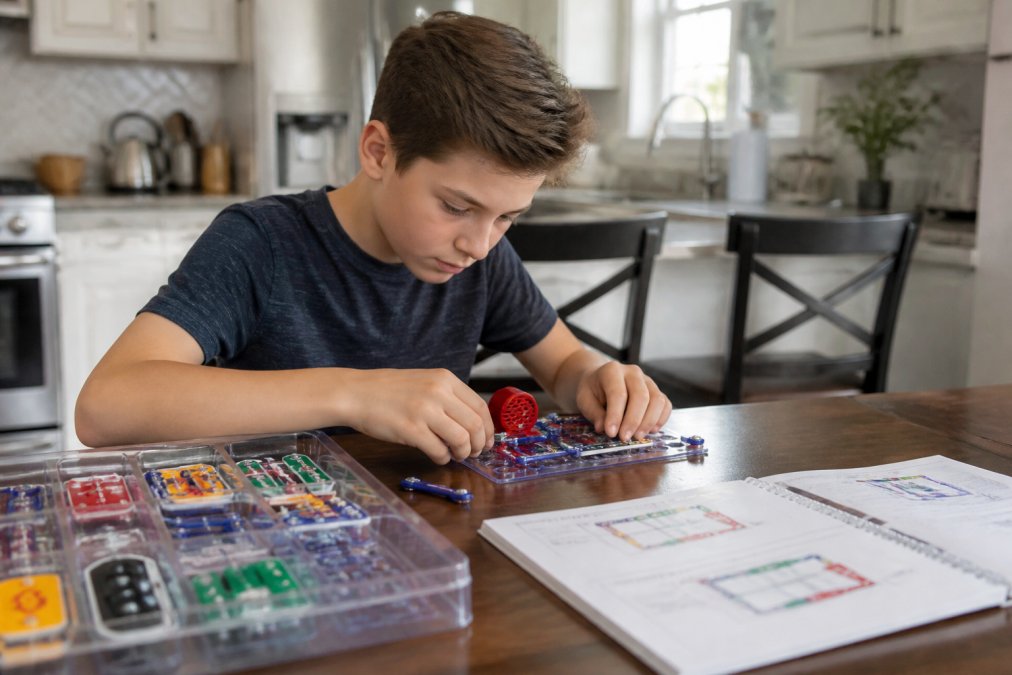
Snap Circuits Jr. SC-100: Electronics Without the Overwhelm
Snap Circuits Jr. is the gateway to electrical engineering. The kit includes over 30 snap-together parts and a full-color manual with instructions for 100 projects: AM radios, burglar alarms, doorbells, and electronic games. No soldering, no tools, no frustrated parent holding a hot iron.
The snap-together design means a kid can go from opening the box to a working circuit in under 10 minutes. That immediate feedback loop keeps them coming back. Projects scale in complexity, providing genuine progression.
Some kids who are already technically confident will outgrow the basic projects faster than expected. You'll also need AA batteries, which are not included.
ThinkFun Gravity Maze: Spatial Reasoning Through Play
Spatial reasoning is one of the strongest predictors of success in STEM fields, according to research published by the American Psychological Association. ThinkFun Gravity Maze builds exactly that skill through a marble-run logic puzzle format.
The game includes 60 challenges ranging from beginner to expert, a game grid, nine translucent towers, and three marbles. The challenge: build a path so the marble drops from start to target. It's primarily single-player, though small groups can collaborate on harder challenges.
The beginner levels will feel easy for a sharp 12-year-old. Jump straight to intermediate and expert to keep it genuinely challenging.
Turing Tumble: Computer Logic Without a Screen
Turing Tumble teaches binary, programming logic, and computational thinking without a single pixel of screen time. Players build mechanical computers, actual marble-powered machines, to solve logic puzzles.
It comes with a puzzle-and-comic-book hybrid containing 60 logic puzzles that build progressively. Kids who finish the book can design their own machines. At $69.95 to $76.95, it's the most expensive single item on this list, but for a 12-year-old with analytical tendencies, this gift could shape a career.
Best History Books for 12 Year Old Boys
The best history books for 12 year old boys do not read like textbooks. A 12-year-old who "doesn't like reading" almost always means he hasn't found the right book yet. The format matters as much as the content.

Great Battles for Boys: The Series That Turns Reluctant Readers Around
Great Battles for Boys was written by a teacher with a reluctant reader at home. Every structural choice reflects what actually works with real kids: short, punchy chapters that end on cliffhangers, real battlefield photography instead of cartoons, and detailed maps that let a kid track exactly what happened and where. The historical range spans over 2,000 years, from ancient warriors to Vietnam.
The chapters are designed so a kid with ADHD or dyslexia can finish one in a single sitting and feel the satisfaction of completion. That momentum builds reading proficiency. Real parents report that their sons "became voracious readers" after starting the series, with teachers noting dramatic jumps in reading proficiency. Schools that purchased sets found that students with dyslexia and autism were asking to drop everything to read.
The series includes challenging quizzes for every chapter with answer keys, making it genuinely useful for homeschooling parents who need curriculum-grade material.
Best for: Boys aged 8-13 who are reluctant readers, kids with ADHD or dyslexia, homeschooling families, and grandparents looking for a gift with real educational impact.
How to Encourage Reading in Reluctant Readers
Reluctant readers are not non-readers. They are kids who have not yet found material that meets them where they are.
The most effective strategy is format-first selection. Before choosing a book by topic or reading level, choose by chapter length, visual density, and pacing. Short chapters with natural stopping points give a struggling reader the experience of finishing something, and that feeling of completion builds momentum. According to guidance from the National Reading Panel, repeated successful reading experiences are a core driver of reading motivation.
Effective principles:
- Let the kid choose the topic. Interest in the subject overrides almost every other barrier to reading.
- Start with non-fiction. Many reluctant readers engage immediately with action-oriented non-fiction, particularly military history, science, or sports.
- Reduce the stakes. No comprehension quizzes, no reading logs. Just the book.
- Read alongside them. A parent or grandparent who picks up the same book and talks about it at dinner turns reading into a shared experience rather than a chore.
- Use books with visual anchors. Real photographs, maps, and diagrams give a struggling reader something to orient to when the text gets dense.
The worst approach is assigning a book that feels like school. The best approach is putting the right book in a kid's hands and getting out of the way.
Science Experiment Sets and Creative Educational Gifts for 12 Year Olds
Science kits bridge the gap between classroom theory and hands-on discovery when done well. Done poorly, they're a box of chemicals that produces one underwhelming reaction and sits in a closet.
National Geographic Mega Science Series: 45 Hands-On Experiments
The National Geographic Mega Science Series Earth Science Kit contains 45 experiments across earth science, chemistry, and "science magic": crystal growing, volcano building, gemstone digs, and more. It includes a full-color learning guide that explains the science behind each experiment, plus a bonus guide with 30 additional experiments using household items.
The variety is what works: a kid who burns through the volcano experiment in an afternoon still has dozens of other activities to explore. Some experiments take days to complete (crystal growing requires patience), and a few activities produce mess that parents should anticipate.
Best for: Curious kids aged 8 and up who want to do real science at home.
KiwiCo Eureka Crate: Monthly Engineering Projects for Teens
KiwiCo's Eureka Crate delivers a new engineering or design project each month. Past projects have included an electric pencil sharpener, a ukulele, and an articulated desk lamp. Every crate comes with a "blueprint" magazine explaining the science and engineering principles behind the build. The subscription starts at $32.95 per month.
Best for: Teens aged 12 and up who enjoy building things that actually work. Projects are sophisticated enough to hold a 12-year-old's attention without requiring adult supervision.
Honest limitation: The subscription model means ongoing cost. Consider a three-month gift subscription as a trial before committing to a full year.
Logic, Strategy, and Screen-Free Learning Activities
Screen-free learning gives kids experiences that screens cannot replicate: tactile feedback, physical cause-and-effect, and the satisfaction of solving something with their hands.
The best logic and strategy gifts for 12-year-olds scale in difficulty, reward repeated play, and produce genuine cognitive development. According to research from the American Academy of Pediatrics, open-ended play involving problem-solving supports executive function development in ways that passive screen time does not.
Top screen-free picks for this age group:
| Activity | Skill Focus | Solo or Group | Difficulty |
|---|---|---|---|
| Turing Tumble | Computer logic, binary | Solo | High |
| ThinkFun Gravity Maze | Spatial reasoning | Solo/small group | Medium-High |
| Logic puzzles (book sets) | Deductive reasoning | Solo | Adjustable |
| Chess | Strategy, planning | 2 players | High |
| Snap Circuits Jr. | Electronics, engineering | Solo/parent-child | Medium |
A kid who spends an hour debugging a Turing Tumble machine is doing the same cognitive work as a programmer debugging code, just with marbles instead of syntax errors. For kids who struggle with sustained attention, shorter-session activities like ThinkFun Gravity Maze are more accessible entry points. For kids who want deep engagement, Turing Tumble and chess reward hours of focused play.
Gifts That Work for Neurodivergent Kids and Different Learning Styles
Many of the kids who most need engaging educational gifts, kids with ADHD, dyslexia, autism spectrum, or sensory processing differences, are also the ones most likely to be written off as "not readers" or "not STEM kids." Neurodivergent kids often thrive with educational gifts that match their learning style.
For kids with ADHD:
- Short-chapter books with high action and visual anchors (Great Battles for Boys is specifically designed with this in mind)
- Hands-on kits with immediate results, like Snap Circuits Jr.
- Logic games with discrete, completable challenges
For kids with dyslexia:
- Books with real photographs that support comprehension
- Audio supplements where available
- Non-fiction formats where prior knowledge helps decode unfamiliar words
For kids on the autism spectrum:
- Rule-based games with clear structure, like Turing Tumble or chess
- Science kits with predictable cause-and-effect outcomes
- History books with maps and timelines that provide visual frameworks
For tactile learners:
- Any hands-on kit takes priority over workbooks or digital platforms
- KiwiCo Eureka Crate and Snap Circuits both deliver strong tactile learning experiences
Which Educational Gift Should You Actually Buy?
The right educational gift for a 12-year-old depends on one question: what does this specific kid actually care about?
Here's a practical decision framework:
| If the kid... | Buy this |
|---|---|
| Avoids reading but loves action and history | Great Battles for Boys |
| Wants to know how things work | Snap Circuits Jr. SC-100 |
| Enjoys puzzles and thinks spatially | ThinkFun Gravity Maze or Turing Tumble |
| Loves science and wants to experiment | National Geographic Mega Science Kit |
| Needs ongoing challenge month after month | KiwiCo Eureka Crate |
| Is a gamer interested in how games are built | CodeCombat |
| Has ADHD, dyslexia, or finds school hard | Great Battles for Boys |
The most common mistake is buying what looks impressive on paper rather than what matches the child's actual interests. A chemistry set for a kid who hates science is not an educational gift, it's a wish. A history book series for a kid who claims to hate reading but loves military strategy games? That's a match.
The educational gifts for 12 year olds that generate the most genuine engagement are the ones that meet a kid's existing curiosity and then expand it. Start there, and the learning follows naturally.
Frequently Asked Questions
What is a good educational gift for a 12-year-old boy?
The best educational gifts for 12-year-old boys match their interests while building real skills. STEM kits like Snap Circuits or ThinkFun Gravity Maze develop engineering and spatial reasoning through hands-on play. For boys who resist reading, action-packed history books like Great Battles for Boys use short chapters, real battlefield photos, and maps to pull reluctant readers in. The key is choosing something that feels like a hobby, not homework.
How do you choose age-appropriate educational gifts for middle schoolers?
Look for gifts that match the developmental stage of a 12-year-old: they want challenge, independence, and relevance. Avoid anything that feels too young or too abstract. Strong picks offer open-ended play or progressive difficulty, so kids don't outgrow them in a week. For reluctant readers, choose books with short chapters and visual content. For hands-on learners, prioritize kits with 60 or more challenges or projects rather than a single activity.
What to get a 12 year old who has everything?
Subscription-based gifts work well here because they keep delivering. KiwiCo Eureka Crate sends a new engineering project every month, and MEL Science delivers chemistry and physics kits with augmented reality lessons. For something one-time but deeply engaging, the Great Battles for Boys series covers over 2,000 years of military history across multiple volumes, giving a kid plenty to work through rather than a single item they finish in an afternoon.
Are history books actually good educational gifts for boys who hate reading?
They can be, but only if the format is right. Traditional history textbooks rarely work for reluctant readers. Series like Great Battles for Boys are specifically designed for this problem: chapters are short, end on cliffhangers, and include real battlefield photography and maps rather than dense text blocks. Parents and teachers have reported that boys with dyslexia and ADHD ask to read these books independently, which is a meaningful result for a format that usually struggles to hold that audience.
What educational gifts help kids with ADHD or dyslexia?
Tactile, hands-on gifts tend to work best: electronics kits, marble logic games, and building sets give kids something physical to manipulate, which supports focus. For reading, short-chapter books with strong visual content, like the Great Battles for Boys series, reduce the cognitive load that long text blocks create. Real customers have reported that students with dyslexia and autism specifically ask to read the series during free time, suggesting the format genuinely reduces barriers rather than just claiming to.
Finding the right gift for a reluctant reader or a kid who's lost interest in school is genuinely hard. Great Battles for Boys was built specifically for this problem: short, punchy chapters, real battlefield photographs, and detailed maps that turn military history into something a 12-year-old actually wants to read. Over one million copies sold, and teachers consistently report measurable jumps in reading proficiency. GET HIM READING TODAY →
This article was written using GrandRanker


Leave a comment